What Is Account Abstraction?
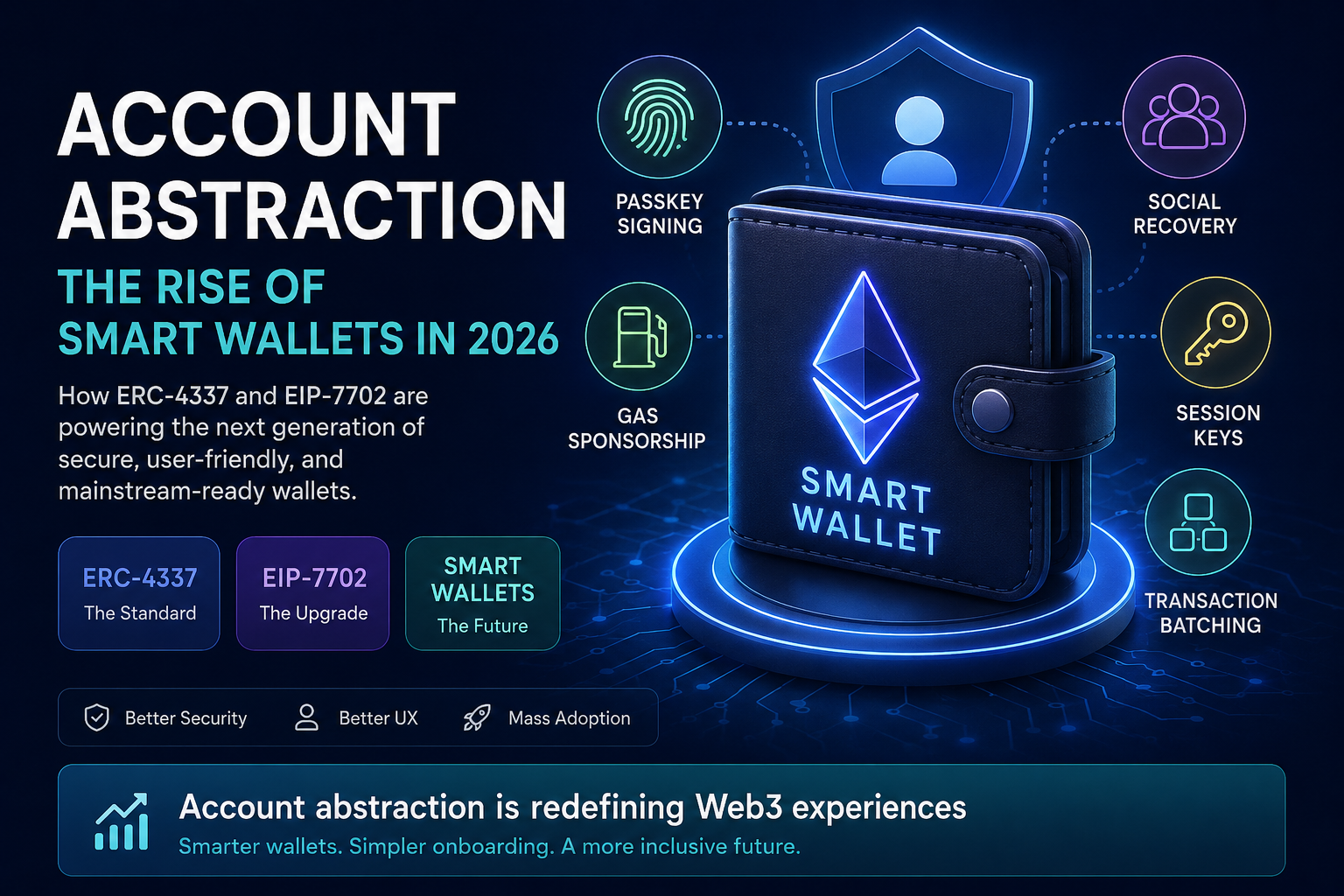
Account abstraction is a blockchain technology that allows crypto wallets to function as programmable smart contracts instead of traditional externally owned accounts (EOAs). Through standards such as ERC-4337 and EIP-7702, account abstraction enables features like passkey authentication, gas sponsorship, social recovery, transaction batching, and session keys.
In 2026, account abstraction has become a core component of modern smart wallets, improving security and user experience for consumer-facing Web3 applications.
Four years ago, EIP-4337 was deployed to the Ethereum mainnet to mild applause and a lot of "we'll see." The pitch was real, smart-contract wallets without consensus-layer changes, but the products that needed it weren't built, the tooling was rough, and the UX wasn't obviously better than a regular EOA.
It feels different now. Account abstraction infrastructure has matured, smart wallets have improved, and real-world applications are finally shipping at scale. The infrastructure caught up, the wallets caught up, and there are real shipping products that would have been impossible without account abstraction. Worth a look.
Features Enabled by Account Abstraction
Three primitives that ERC-4337 unlocked, which now ship in mainstream wallets:
- Passkey signing. A smart account can authorize transactions with any signature scheme its contract recognizes. The default scheme moved from secp256k1 (Ethereum's native curve) to passkey-compatible signatures over secp256r1, which means your phone's secure enclave or a YubiKey can sign transactions directly. No seed phrase to lose.
- Paymasters. A third party can sponsor gas. dApps can pay for their users' transactions; users can pay gas in any token the paymaster accepts (USDC, USDT, your dApp's own token).
- Session keys. A smart account can authorize a limited signer for a fixed duration with a fixed scope ("this key can call
transferon this contract, up to $100, expiring in 24 hours"). This is the primitive that finally makes "log into dApp once, transact freely" safe.
Benefits of Account Abstraction
Account abstraction improves both security and usability in blockchain applications.
Key benefits include:
- Passwordless authentication through passkeys
- Social recovery without custodians
- Gas sponsorship for new users
- Transaction batching
- Better onboarding for mainstream users
- Safer permission management through session keys
Account abstraction is widely considered one of the most important improvements to blockchain wallet infrastructure. By removing many of the usability limitations of externally owned accounts, account abstraction helps bridge the gap between traditional Web2 user experiences and decentralized applications.
ERC-4337 Explained
ERC-4337 is the Ethereum standard that enables account abstraction without requiring changes to Ethereum's consensus layer. It introduces smart accounts, UserOperations, bundlers, and paymasters, allowing wallets to offer advanced functionality while remaining compatible with existing Ethereum infrastructure.
ERC-4337 is the foundation behind most production-ready smart wallets in 2026.
Real-World Account Abstraction Use Cases
The breakout categories in 2026:
| Category | What AA enables | Production example |
|---|---|---|
| Onchain games | Session keys + paymaster = sign once, play freely | Multiple shipped fully-onchain games with millions of MAU |
| Consumer payments | Passkey signing + gasless transfers | Coinbase Smart Wallet, Argent X, Daimo |
| dApp UX | "Connect wallet" without a 12-word seed phrase | Most major dApps now offer a smart-account login path |
| Social recovery | Spread account control across N guardians | The default in every new consumer wallet shipped this year |
The pattern is consistent: products that needed AA to feel sane became genuinely usable; products that could get by with EOAs mostly kept using EOAs.
What changed structurally
Three things made AA finally work in 2026:
1. Bundler infrastructure matured
The original ERC-4337 spec defined a mempool for "UserOperations" that relied on third-party bundlers. For years, this was a brittle layer. Pimlico, Stackup, and Alchemy now run production bundler infrastructure with SLAs, and every major chain has at least one well-funded bundler provider. UserOps goes through.
2. Paymaster economics has been solved
Sponsoring gas for users felt like an unbounded liability until paymasters added rate limits, allowlists, and tight per-user policies. Apps can now sponsor "your first 10 transactions" without worrying about griefing.
3. EIP-7702 closed the migration gap
The hardest part of AA adoption used to be that existing EOA users had to move to a new address. EIP-7702 (deployed to mainnet in late 2025) lets an EOA temporarily delegate execution to a smart-contract account without changing addresses. Users don't have to migrate; they upgrade in place. This was the unlock.
What Is EIP-7702?
EIP-7702 allows existing externally owned accounts (EOAs) to delegate execution to smart-contract logic temporarily. This enables users to gain account abstraction features without changing wallet addresses, significantly reducing migration friction and accelerating adoption.
Social Recovery Explained
The single hardest thing about crypto for non-crypto-native users has always been: lose your seed phrase, lose your money. AA's social recovery is the first credible answer to this that doesn't involve trusting a custodian.
The default flow in 2026 looks like:
- The user creates a smart account and signs in with their device passkey.
- User nominates 3 guardians (friends, family, a hardware key in a safe deposit box, a Web2 service like Privy).
- If the user loses access, a 2-of-3 guardian quorum can rotate the signing key after a time lock (typically 48 hours).
This is the recovery model that most consumer wallets shipped this year. It's not perfect — guardians can collude, the timelock window is a target — but it's a real answer to the seed-phrase problem.
Challenges of Account Abstraction
Two areas where AA is not yet boring:
- Cross-chain account state. Your smart account on Base is a different contract than your smart account on Optimism, even at the "same" address (via CREATE2). Replicating session keys and recovery across chains is still per-chain work.
- Wallet portability. Smart-account contracts are implementation- specific. Moving from Coinbase Smart Wallet to Safe is not a one-click export-import flow. ERC-7579 standardizes the modular wallet interface, but adoption is partial.
Why SaaS Builders Should Care About Account Abstraction
Account abstraction has implications far beyond crypto wallets. For SaaS products building Web3 integrations, smart accounts eliminate many onboarding challenges that traditionally prevented mainstream adoption.
Users can sign in with passkeys, recover accounts without seed phrases, and perform transactions without managing native gas tokens. These improvements create onboarding experiences closer to traditional Web2 applications while retaining blockchain functionality.
As Web3 adoption expands, account abstraction is likely to become a standard infrastructure layer for consumer-facing decentralized applications.
The Future of Smart Wallets
If you're building a consumer-facing onchain product in 2026 and you're asking users to install MetaMask and write down a seed phrase, you are fighting the platform. Smart accounts with passkey signing and social recovery are the new default for consumer UX. The tooling exists, the patterns are documented, and the user experience is finally good enough to compete with Web2 onboarding.
If you're building a power-user trading tool, an EOA is still fine. The two audiences are different, and the wallets they want are different. That's a feature, not a bug.
Frequently Asked Questions
What is account abstraction?
Account abstraction allows blockchain accounts to operate as programmable smart contracts rather than traditional externally owned accounts.
What is ERC-4337?
ERC-4337 is the Ethereum standard that enables account abstraction without requiring protocol-level changes.
What is EIP-7702?
EIP-7702 allows EOAs to temporarily delegate execution to smart contract logic while keeping the same address.
What is a smart wallet?
A smart wallet is a blockchain wallet powered by account abstraction, enabling passkeys, social recovery, gas sponsorship, and transaction batching.
Is account abstraction secure?
When implemented correctly, account abstraction can improve wallet security through programmable permissions, passkeys, and recovery mechanisms.
Can account abstraction replace seed phrases?
Many modern smart wallets use passkeys and social recovery, reducing dependence on traditional seed phrases.